2026 | June 21
The Role of In-House Drivers in Safer Public Transport
Examining how structured driver training and monitoring improve safety and service reliability.
In public transport systems, vehicles and infrastructure form the visible framework of operations. However, the true strength of any transport network lies in its people, particularly the drivers. Drivers are responsible not only for operating vehicles but for ensuring passenger safety, maintaining punctuality, and upholding service discipline. In large-scale transport systems, the structure of driver management plays a critical role in shaping operational outcomes.
An in-house driver model, where drivers are directly employed and trained within the organisation, offers greater oversight and consistency than outsourced arrangements. While third-party staffing may provide short-term flexibility, structured in-house systems create long-term operational stability.
Accountability Through Direct Employment
When drivers are part of the organisation’s payroll, operational accountability becomes clearer and more consistent. Defined policies, performance metrics, and behavioural standards can be applied uniformly across depots and cities.
Direct employment reduces dependency on external vendors, which often introduces variability in service standards. With in-house drivers, attendance, conduct, compliance, and performance tracking remain centralised. This consistency strengthens operational discipline and reduces gaps in responsibility.
Lower attrition rates are another advantage. A stable workforce allows drivers to become familiar with routes, vehicles, and safety expectations. Familiarity reduces operational risk and improves efficiency.
Building a Culture of Safety Through Continuous Training
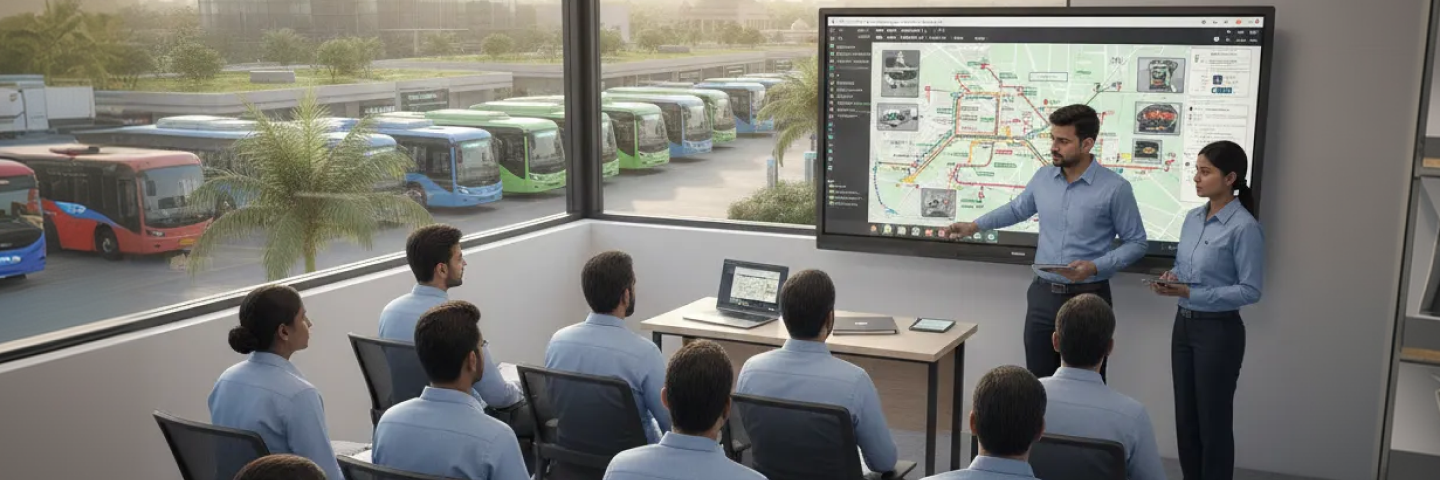
Safety in public transport is not achieved through one-time certification. It requires continuous reinforcement through structured training programmes. In-house driver models enable standardised training across all operational units.
Training modules typically include defensive driving techniques, road safety regulations, traffic system awareness, and vehicle handling practices. Behavioural training also focuses on attentiveness, patience in high-traffic environments, and emergency response preparedness.
When drivers receive regular refreshers, safety becomes embedded in daily practice rather than treated as a procedural requirement. This consistent reinforcement supports accident prevention and improves long-term performance outcomes.
Monitoring, Evaluation, and Behavioural Discipline
Modern transport operations rely on data-backed oversight. Driver behaviour monitoring systems track metrics such as speed patterns, harsh braking, idling time, and route adherence. These indicators provide insight into driving discipline and fuel efficiency.
Monitoring does not replace human supervision. Instead, it complements structured feedback mechanisms. Regular performance reviews allow drivers to understand areas for improvement and reinforce positive habits.
In-house management ensures that corrective action, retraining, or counselling can be implemented promptly when required. This responsiveness reduces risk exposure and strengthens accountability.
Operational Advantages of In-House Driver Models
- Standardised Training Across Depots: Uniform training protocols ensure consistent service delivery. Drivers across cities operate under the same safety and performance standards.
- Stronger Compliance Control: Direct oversight allows easier implementation of regulatory requirements and internal safety policies without third-party coordination gaps.
- Reduced Operational Variability: With payroll drivers, service expectations remain aligned. This reduces the inconsistency that can arise from outsourced staffing models.
- Improved Passenger Experience: Professional conduct, communication discipline, and controlled driving behaviour enhance commuter confidence and comfort.
- The Impact on Service Reliability: Drivers directly influence punctuality and operational stability. Disciplined driving reduces mechanical strain caused by abrupt acceleration or braking. Familiarity with assigned routes improves time management and reduces navigation errors.
Structured rostering also improves continuity. When drivers operate within organised schedules, fatigue management becomes easier. This supports both safety and efficiency. In-house driver systems also strengthen coordination with maintenance teams. Drivers who report vehicle performance issues consistently enable early detection of mechanical concerns. This integration improves preventive maintenance outcomes.
Public transport safety is built on structured systems, disciplined planning, and responsible workforce management. While technology and infrastructure support operations, drivers ultimately determine on-road reliability. An in-house driver model strengthens accountability, reinforces compliance, and promotes consistent training standards. In large-scale transport networks, safety is not accidental. It is the result of sustained oversight, continuous improvement, and direct engagement with the workforce. When drivers are managed within structured organisational systems, public transport becomes safer, more reliable, and operationally stable.
FAQs
-
Why are in-house drivers considered safer than outsourced drivers?
In-house drivers operate under consistent training, monitoring, and accountability frameworks, reducing variability in service standards.
-
What type of training improves public transport safety?
Defensive driving, regulatory awareness, behavioural discipline, and emergency response training significantly improve safety outcomes.
-
How does driver monitoring improve reliability?
Monitoring driving behaviour supports early correction of unsafe habits and reinforces disciplined operational standards.
 Share
Share